Where to Eat Mi Quang in Da Nang: the Shops, the Prices and the Jellyfish Version
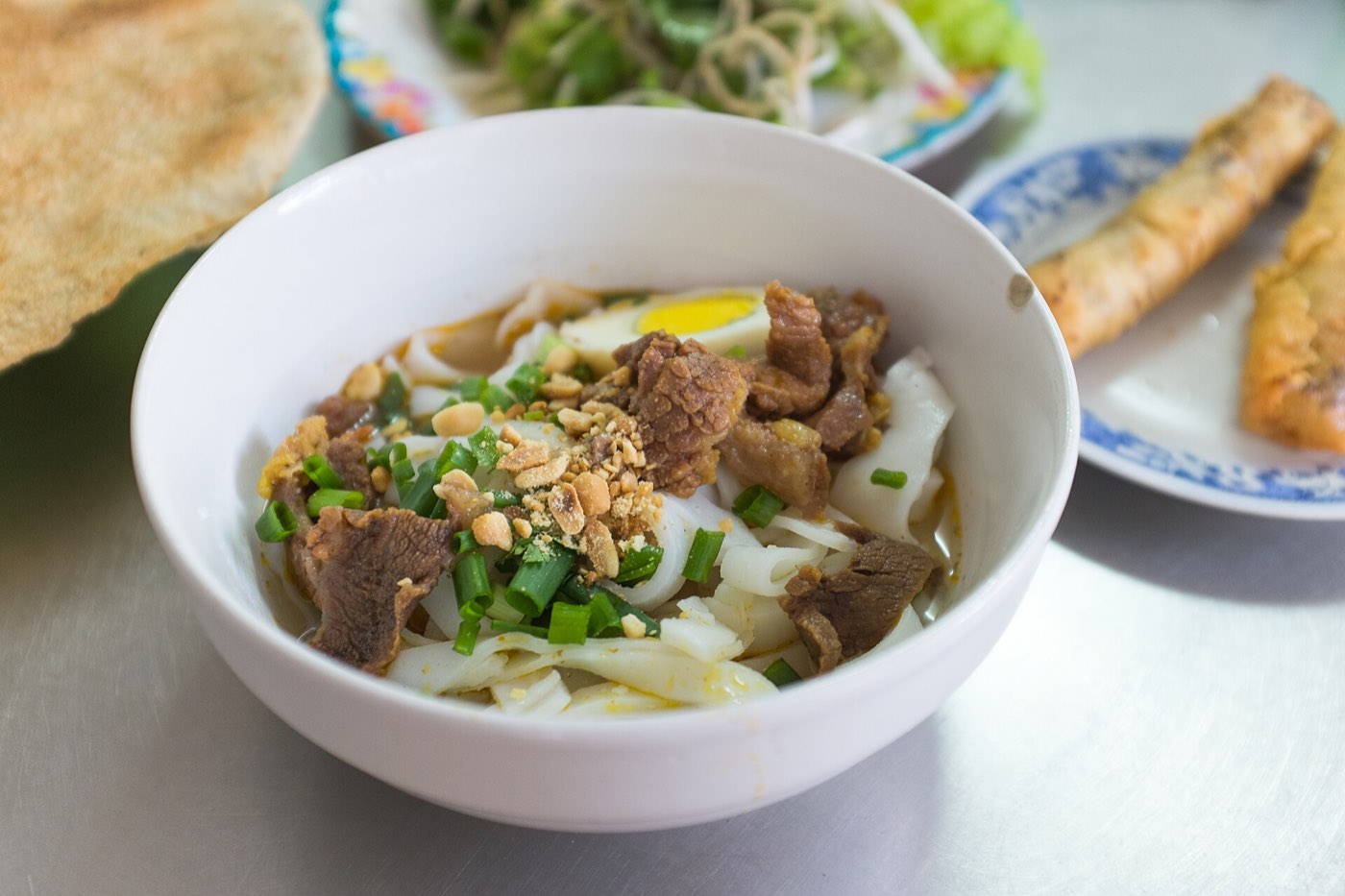
Mì Quảng is the dish Da Nang and the old Quảng Nam province are built on: wide turmeric-yellow rice noodles served semi-dry in a small pool of concentrated broth rather than a bowl of soup, with peanuts, a heap of raw herbs and a giant toasted sesame rice cracker you snap over the top. It costs 25,000–70,000₫ (about $1–2.75) and it is served from about 06:00 until the pot runs out — which at the famous shops means early afternoon, and around 13:00 for the jellyfish version at Hồng Vân. Start at Mì Quảng 1A, 1A Hải Phòng, which is Michelin Selected and the old-guard institution. Then decide whether you want jellyfish, eel or frog in it.
Not a soup, and that is the whole point
Every visitor who orders mì Quảng expecting phở gets a surprise: the broth barely covers the bottom of the bowl. That is correct. It is meant to be like that.
Mì Quảng is built the opposite way round to a northern noodle soup. Instead of a large volume of gentle stock, you get a small amount of very concentrated broth — reduced from pork or chicken bones, turmeric, shallots and fish sauce — sitting under wide flat rice noodles that have been coloured yellow with turmeric. The bowl arrives semi-dry. You stir it, and the noodles absorb what is there.
On top: peanuts, crushed but not powdered, for texture. Quail eggs. Whatever protein you ordered. And a plate of raw herbs — Vietnamese mint, basil, banana blossom, lettuce, bean sprouts — that is not a garnish but roughly a third of the dish by volume. You tear it in yourself. Finally the bánh tráng mè, a dinner-plate-sized toasted sesame rice cracker, which you snap into shards and either eat alongside or crumble in. Nobody eats mì Quảng without it.
The flavour is nothing like Hanoi's phở or Saigon's hủ tiếu. It is salty, turmeric-forward and dense, and eating it takes about ten minutes because the local convention is to eat quickly and leave. If you sit for an hour, you are the only one doing so.
One practical note: the shops that do this well are single-dish, single-shift operations. There is no menu to read and no dinner service. Get up, eat it before 10:00, and treat the rest of the day as a bonus. The wider list of what else to eat is on the ten dishes page.
Where to eat mi quang in Da Nang, by address
The full spread, from the Michelin Selected institution to the 25,000₫ neighbourhood bowl. The important column is the last one and it is not really about quality — every shop here is good. It is about which one fits the morning you have.
| Shop | Where | Status | The version | Verdict |
|---|---|---|---|---|
| Mì Quảng 1A | 1A Hải Phòng, Hải Châu | Michelin Selected | The old-guard institution and the safest first bowl in the city. Classic tôm thịt — prawn and pork — done the way the dish is supposed to taste before you start experimenting. | WORTH IT |
| Mỳ Quảng Sứa Hồng Vân | 59C Lê Hồng Phong | Bib Gourmand | The jellyfish version, and the reason to set an alarm. Sứa is cool, crunchy and completely unlike any other protein in Vietnamese cooking. Sells out by about 13:00 — often earlier at weekends. | WORTH IT |
| Quê Xưa | 165–167 Núi Thành | Bib Gourmand 2025 | The efficient choice: mì Quảng and bánh tráng cuốn thịt heo under one roof, so a mixed group with one person who does not want noodles is solved in a single stop. | WORTH IT |
| Mỳ Quảng Cô Sáu | 37B Phạm Quang Ảnh | Michelin Selected | The mỳ thập cẩm đặc biệt — the mixed special, with everything in it. Order this if you cannot choose between the variations, because it is all of them at once. | WORTH IT |
| Mỳ Quảng Bà Mua | 95A Nguyễn Trí Phương · 44 Lê Đình Dương · 22 Trưng Nữ Vương | ~10 branches | The local chain, and the one you will actually be able to reach. Consistent, clean, family-friendly and open across more of the day than the single-shift shops. Not the best bowl in town; comfortably the most convenient. | WORTH IT |
| Mì Quảng Thi | 251 Hoàng Diệu | Cheap tier | About 25,000₫ (~$1), which is the floor for this dish anywhere. Plastic stools, no English, and a completely respectable bowl. | WORTH IT |
| Mì Quảng Dung | 121 Đỗ Bá | Beach side | The one that matters if you are staying on the My Khe strip and do not want to cross the river at 07:00. Local prices, walkable from the beach hotels. | WORTH IT |
| Giao Thủy · Bếp Trang · Bà Vị · Hương Quê · Bà Lữ · Bà Bích | Across the city; Bếp Trang has three branches | Cheap tier | The specialist tier. Giao Thủy does the eel version, Bếp Trang does frog. The rest are solid neighbourhood shops of the sort every district has and no guidebook lists. | DEPENDS |
| A cooking class | Market trip plus a kitchen | Compare classes | Mì Quảng is on essentially every five-dish syllabus in the city, and it is the one worth learning because the turmeric broth reduction is the part you cannot guess at home. $25–45 with the market walk. | WORTH IT |
Addresses and Michelin status checked August 2026. Per-shop pricing is not separately published for most of these — the reliable figures are the 25,000–70,000₫ city-wide band and Mì Quảng Thi at about 25,000₫, so treat the rest as sitting inside that range. Cash only at all of them.
Seven versions, and three you will only find on this coast
Mì Quảng is a format, not a recipe. What goes in it changes by shop, and three of the versions are effectively Da Nang-only.
Tôm thịt — prawn and pork — is the default and the one to start with. Gà is chicken, usually on the bone, and the mildest. Cá lóc is snakehead fish, firmer and cleaner-tasting than it sounds. Sườn is pork rib, the richest of the four.
Then the local specials. Sứa is jellyfish: cool, translucent, slightly crunchy, with no fishiness at all, and it works because the texture contrast against soft noodles is the whole idea. This is what Mỳ Quảng Sứa Hồng Vân on Lê Hồng Phong holds its Bib Gourmand for, and it is gone by about 13:00. Lươn is eel — darker, muddier, richer — and Giao Thủy is the name attached to it. Ếch is frog, which Bếp Trang does across three branches and which tastes, predictably and genuinely, like a very fine chicken.
If you want to make the decision once and be done, order the mỳ thập cẩm đặc biệt at Mỳ Quảng Cô Sáu on Phạm Quang Ảnh — the mixed special, which puts most of the above in one bowl. It is Michelin Selected and it removes the problem.
Five things nobody tells you at the table
The bowl arrives looking dry and under-sauced. It is supposed to. Turn it over two or three times with the chopsticks so the concentrated broth coats every noodle, then taste. People who complain that mì Quảng is bland almost always ate it unstirred.
That side plate of raw greens is not decoration and it is not a salad course. Tear the leaves and drop them in until the bowl looks about a third green. Central Vietnamese cooking is intensely salty and the herbs are what balances it.
The dinner-plate-sized sesame cracker (bánh tráng mè) is part of the dish. Break it into shards over the bowl or scoop with it. Leaving it on the table intact is the clearest sign at any mì Quảng shop that a table is new to this.
Fresh chilli, lime and often a small dish of fish sauce or chilli paste sit on every table. The kitchen deliberately under-seasons for heat because everyone's tolerance differs. Add, taste, add again.
The local convention is eight to ten minutes. Nobody lingers, tables turn constantly, and at 07:30 there are people standing. Take your time by all means, but do not expect a café atmosphere — this is a working breakfast.
Every shop on this page is cash-only and a bowl costs 25,000–70,000₫. Handing over a 500,000₫ note for a 35,000₫ breakfast is a genuine problem at 06:30. Carry 20,000₫ and 50,000₫ notes.
Mi Quang, practically
Learn to make it, or get taken to it
A bowl costs 25,000–70,000₫ and needs nothing booked, so judge these on what they add rather than on the price of the food. A class teaches you the turmeric broth reduction, which is the part that does not survive a written recipe. A food tour gets you to shops with no English sign.
Mi Quang FAQ
What is mì Quảng?
A central Vietnamese noodle dish of wide turmeric-yellow rice noodles served semi-dry — with only a small amount of very concentrated broth — plus peanuts, quail eggs, raw herbs and a large toasted sesame rice cracker. It comes from Quảng Nam, the province immediately south of Da Nang that merged into the city in July 2025, and it costs 25,000–70,000₫.
Where is the best mì Quảng in Da Nang?
Mì Quảng 1A at 1A Hải Phòng is the institution and is Michelin Selected — the safest first bowl. For the famous jellyfish version, Mỳ Quảng Sứa Hồng Vân at 59C Lê Hồng Phong holds a Bib Gourmand, but it sells out by about 13:00. Mỳ Quảng Cô Sáu at 37B Phạm Quang Ảnh, also Michelin Selected, does the mixed special.
How much does mì Quảng cost?
25,000–70,000₫, roughly $1 to $2.75, depending on the shop and what protein goes in it. Mì Quảng Thi at 251 Hoàng Diệu is about 25,000₫ and is the practical floor. The Michelin-listed shops sit in the same band — a Bib Gourmand in Vietnam signals cheap and good, not expensive.
Is mì Quảng a soup?
No, and this is the single most common misunderstanding. There is only a shallow pool of intense broth at the bottom of the bowl, and you stir the noodles through it rather than drinking it. If you were expecting phở you will think the bowl is under-filled. It is not.
What time should I eat mì Quảng?
Breakfast — from about 06:00 — through to early lunch. These are single-shift shops that close when the pot is empty rather than at a fixed hour, and the famous ones drain by early afternoon. If jellyfish mì Quảng at Hồng Vân is the plan, be there before 13:00.
What is jellyfish mì Quảng like?
Cool, translucent, faintly crunchy and not fishy at all. The point is textural: crisp jellyfish against soft noodles, the same logic as the sesame cracker. Mỳ Quảng Sứa Hồng Vân on Lê Hồng Phong holds a Bib Gourmand specifically for this version, and it is the most distinctive bowl in the city.
What is the difference between mì Quảng and phở?
Almost everything. Phở is a northern dish of thin flat noodles in a large bowl of clear, gently spiced beef or chicken broth. Mì Quảng is central: wider turmeric noodles, barely any liquid, a much saltier and denser flavour, peanuts, a mound of raw herbs and a sesame cracker. They are not variations on each other.
Can vegetarians eat mì Quảng?
Not at a standard shop, where the broth is bone-based and fish sauce is structural. Vegetarian mì Quảng chay does exist at dedicated Buddhist restaurants — the ones covered on the vegan page — and appears more widely on the lunar mùng 1 and rằm days when the whole city eats chay.